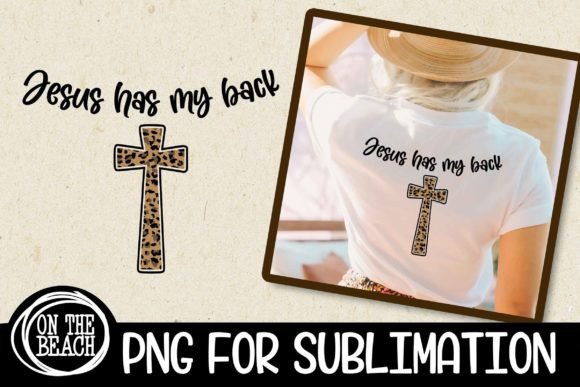
Jesus Has My Back PNG Leopard PNG
If you’ve searched for “Jesus Has My Back PNG Leopard PNG,” you’re likely looking for a bold, faith-infused digital graphic—part spiritual affirmation, part eye-catching design—that works seamlessly across digital and print projects. This isn’t just clipart. It’s a layered concept: a leopard-patterned background (often symbolic of strength, discernment, or divine protection in visual storytelling) paired with the reassuring phrase “Jesus Has My Back.” And because it’s delivered as a PNG with transparency and 300 PPI resolution, it’s built for real-world use—not just scrolling.
What People Often Misunderstand About This File
First, clarity matters: this is a single digital file, not a bundle, template pack, or editable source file (like PSD or AI). Some assume “high printing quality 300 PPI” means it’s automatically sized for banners, T-shirts, or large-format signage—but it’s not. The resolution ensures crisp output only when used at its native dimensions. Enlarging it beyond its original pixel size without proper upscaling will introduce blurriness or pixelation, especially noticeable on physical prints like mugs, posters, or vinyl decals.
Second, the leopard pattern isn’t decorative filler—it’s intentional visual language. In Christian creative circles, leopards sometimes echo biblical imagery (e.g., Jeremiah 5:6 or Hosea 13:7), where the animal symbolizes watchfulness or God’s sovereign presence. But not all leopard textures carry that weight. Low-contrast, overly busy, or poorly balanced patterns can drown out the text—or worse, unintentionally shift the tone from reverent to trendy. That’s why checking the actual preview (not just the thumbnail) is non-negotiable.
1. Assuming “Transparent Background” Means Zero Prep Work
A transparent background lets you drop the image over photos, gradients, or brand colors—but only if your editing tool supports PNG alpha channels. Beginners using basic apps (like older versions of Canva or Microsoft Word) may see a white box instead of true transparency. Before downloading, test the file in your intended platform: paste it into your design software, then place it over a colored shape. If the background stays visible, you’ll need to convert or re-export—wasting time and diluting impact.
2. Overlooking Color Accuracy Across Devices
The phrase “colors shown” refers to how the file appears on the seller’s calibrated monitor—not yours. Without embedded color profiles (like sRGB), what looks rich and warm on a MacBook screen might appear muted on a budget Android tablet or oversaturated on a wide-gamut display. For printed materials, this mismatch can mean gold tones printing as mustard, or deep charcoal grays coming out muddy. Always soft-proof in your design app, and if possible, order a small test print before committing to bulk production.
3. Confusing “Digital File” With “License-Free Use”
This is critical: purchasing the file grants you usage rights—but not unlimited commercial rights unless explicitly stated. Many listings include personal-use-only licenses. That means you can add it to your church bulletin or personal journal, but not to a client’s logo, a Shopify product listing, or merchandise you plan to resell—unless the license permits it. One freelancer assumed otherwise and added the design to a pastor’s conference t-shirt line—only to receive a copyright notice after launch. Always read the license terms before download, not after.
What to Check Before You Download or Buy
- File dimensions in pixels—Is it 2000×2000? 4000×3000? Knowing this helps you gauge scalability. A 1200×1200 file won’t hold up well on an 18×24″ framed print.
- Actual transparency test—Look for a preview showing the design against black AND white backgrounds. If both are provided, the transparency is likely clean.
- Text legibility at 50% scale—Zoom out. Does “Jesus Has My Back” remain readable? If letters blur or merge at smaller sizes, it’s not ideal for social media avatars or mobile app icons.
- Pattern repetition and tile behavior—Some leopard PNGs are designed to repeat seamlessly; others aren’t. If you plan to use it as a full-page background in a PDF devotional, ask the seller whether it tiles—or request a repeatable version.
Better Alternatives When This File Isn’t Quite Right
Not every project needs a leopard motif. If the pattern feels distracting for your audience—a youth group newsletter, a counseling handout, or a minimalist Bible study guide—consider swapping it for a subtle texture (linen, watercolor wash) or a solid-color version with the same phrase. Some creators mistakenly think “more visual interest = more engagement,” but clarity often wins. A clean, well-spaced “Jesus Has My Back” in a trusted serif font over soft sage green can communicate peace and authority more effectively than a high-contrast leopard overlay.
And if you’re building a brand system—say, for a faith-based podcast or small ministry—you’ll want consistency. Using this PNG as a one-off graphic is fine. But relying on it across logos, email headers, and merch without adapting the typography, spacing, or contrast risks visual fatigue. Instead, treat it as inspiration: extract the core message, then build custom assets around it with your own voice and palette.
A Final Note on Intentionality
Digital faith graphics like Jesus Has My Back PNG Leopard PNG serve a real need: helping people express conviction visually, quickly, and beautifully. But their value isn’t in the file itself—it’s in how thoughtfully it’s chosen and applied. That means pausing before clicking “add to cart” to ask: Does this match my audience’s expectations? Will it hold up where I need it most? Does it reflect the weight of the truth it carries?
When you do select it, use it with purpose—not as decoration, but as declaration. Because whether it lives on a laptop wallpaper, a Sunday school handout, or the cover of a prayer journal, the message remains unchanged: trust isn’t abstract. It’s anchored. And sometimes, that truth lands deeper when wrapped in thoughtful design.