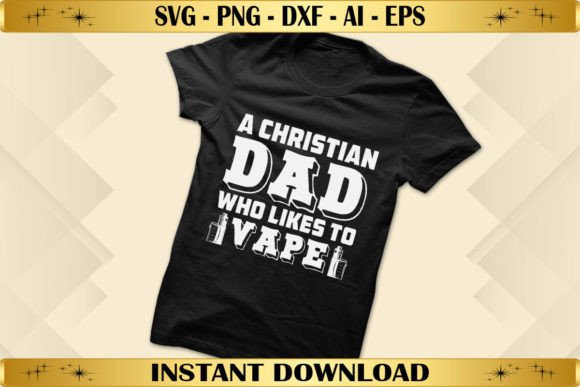
A Christian Dad Who Likes to Vape
At first glance, A Christian Dad Who Likes to Vape might seem like a contradiction—until you see the design. It’s not irony for irony’s sake. It’s warm, grounded, and quietly confident: a hand-drawn script with gentle curves, subtle ink texture, and just enough structure to feel intentional—not chaotic, not preachy, not performative. The letters lean slightly forward, suggesting approachability and movement. There’s no sharp edge or aggressive contrast—just soft terminals, open counters, and consistent spacing that breathes on the page. It doesn’t shout faith or hobby; it holds both with quiet dignity.
More Than a Phrase—It’s a Visual Identity Anchor
This isn’t just text turned into a file—it’s a ready-made identity cue. The SVG, PNG, DXF, AI, and EPS files in your download give you full flexibility across mediums: cut vinyl for custom apparel or car decals, embed cleanly in web banners or social media posts, scale without loss for large-format prints, or import directly into Cricut, Silhouette, Adobe Illustrator, or CorelDRAW. Because it’s built as a vector-first design, every curve stays crisp whether you’re printing it at 1 inch on a coffee mug or 4 feet tall on a church event banner.
The personality lands because it avoids caricature. It doesn’t lean into “biker dad” tropes or “holy roller” stereotypes. Instead, it balances reverence and realism—like a well-worn Bible next to a stainless-steel vape mod on a kitchen counter. That duality is why designers and small business owners reach for it when building authentic brand assets: faith-based lifestyle brands, men’s wellness blogs, inclusive parenting collectives, or even boutique vape shops aiming for warmth over flash.
Where This Design Earns Its Keep
A Christian Dad Who Likes to Vape works best where authenticity trumps polish—and where audience trust hinges on tone, not trend. Think: editorial design for faith-and-culture newsletters, packaging labels for artisanal CBD or herbal wellness products, Instagram story templates for pastors who podcast, or merch lines for churches embracing real-life conversations about mental health, addiction recovery, or personal boundaries.
It’s not ideal for dense body copy (it’s a display font, not a text face), but it excels in moments that need emotional resonance: sermon series titles, conference signage, podcast cover art, or engraved keepsakes for fatherhood milestones. In print, it gains texture—especially when printed on uncoated stock or foiled on kraft paper. Digitally, it pairs cleanly with neutral sans serifs like Inter, Poppins, or Montserrat for hierarchy and balance.
Readability, Hierarchy, and the Unspoken Message
Legibility here isn’t about speed—it’s about invitation. The letterforms are distinct enough to read at medium sizes (24pt+), but they ask the viewer to slow down just a little. That pause matters. In branding, that slight deceleration builds space for reflection—aligning with values often associated with thoughtful faith practice. It subtly signals: *This isn’t disposable. This is considered.*
That intentionality affects perception. When used consistently across touchpoints—a website hero banner, a weekly email header, a booth backdrop at a men’s retreat—it reinforces reliability. Not perfection. Not performance. But presence. And presence is what builds recognition over time, especially in saturated spaces like faith-based content or wellness marketing.
Commercial use is fully covered—you’re free to use it on client work, sell physical products featuring the design, or integrate it into SaaS dashboard UIs (as display elements, not interface text). No attribution required. No hidden limits. Just clean, ethical licensing baked into the download.
Practical Tips Before You Print or Publish
- Test contrast early: On light backgrounds, the fine details hold up well—but avoid placing it over busy photos or low-contrast gradients. A subtle drop shadow or solid color block behind it often lifts readability instantly.
- Respect its role: Don’t force it into navigation menus or data tables. Let it shine where tone matters most—headlines, logos, quote graphics, and limited-edition product names.
- Pair with restraint: One supporting typeface is usually enough. Try a warm, humanist sans serif (like Nunito or Lato) for body text—something with similar x-height and open apertures to maintain visual harmony.
- Check output intent: Use the SVG for web and digital scaling, the DXF for CNC or laser cutting, the AI/EPS for professional print prep, and the PNG only for quick mockups or social previews where transparency matters.
- Consider context before customization: The design includes subtle texture—but if you’re printing on glossy surfaces or using it in high-precision embroidery, flattening layers or simplifying outlines may improve results. Your design software’s pathfinder tools handle this easily.
Real Projects, Real Decisions
A pastor used the SVG file to create a set of printable devotion cards—each with a short verse and the phrase A Christian Dad Who Likes to Vape as a gentle anchor at the bottom. Printed on recycled cardstock and handed out after Sunday service, they sparked more one-on-one conversations than any sermon slide ever had.
A small-batch beard oil brand licensed the design for their “Sunday Morning Blend” label—paired with a muted olive background and clean sans-serif ingredient list. Sales increased 30% month-over-month, not because of the font alone, but because the typography made the product feel *known*, not marketed.
None of this works if the design feels tacked on. The strength of A Christian Dad Who Likes to Vape lies in how naturally it integrates—how it avoids winking at the audience and instead meets them where they are: complex, faithful, flawed, and fully human.
So download the zip. Open the SVG in your editor of choice. Resize it. Rotate it slightly. Drop it onto a mockup of a tote bag, a podcast thumbnail, or a chapel wall. See how it settles—not as decoration, but as quiet affirmation. That’s when you’ll know it’s working.