Proverbs 9:10 – Christian Design: Meaning, Use, and Practical Considerations
The verse “The fear of the Lord is the beginning of wisdom, and the knowledge of the Holy One is understanding” (Proverbs 9:10, ESV) carries enduring theological weight—and when translated into visual form, it becomes a meaningful anchor for faith-centered design. Proverbs 9:10 – Christian Design refers to a category of graphic resources intentionally crafted around this specific biblical principle. Unlike generic religious motifs or broad spiritual themes, these designs center on clarity, reverence, and scriptural fidelity—often pairing the full verse or its core phrase with clean typography, symbolic elements (like an open book, olive branch, or light motif), and restrained color palettes.
What Sets Proverbs 9:10 – Christian Design Apart
Not all Bible-based artwork serves the same purpose. Proverbs 9:10 – Christian Design distinguishes itself through intentionality in both message and medium. It avoids abstraction or ambiguity—prioritizing legibility and doctrinal precision. For example, a well-executed version will cite the verse accurately (including translation preference if specified), use typefaces that support readability at multiple sizes, and avoid decorative flourishes that compete with the text’s gravity.
This focus contrasts with broader categories like “Christian wall art,” which may emphasize aesthetic appeal over textual accuracy, or “faith-themed apparel graphics,” where slogans or metaphors often take precedence over direct Scripture. Similarly, devotional illustrations—such as those depicting Wisdom personified in Proverbs 8—carry rich symbolism but do not center Proverbs 9:10 specifically. In contrast, Proverbs 9:10 – Christian Design treats the verse not as background inspiration but as the primary subject.
File Formats and Real-World Application
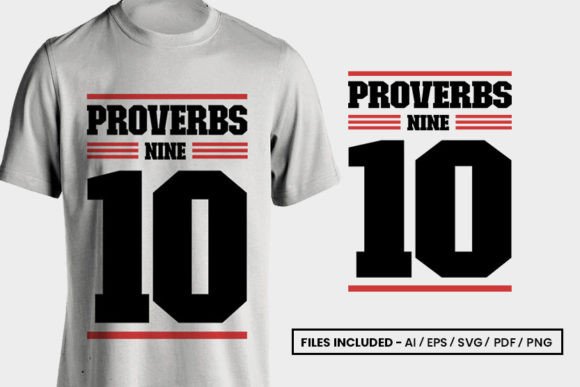
A key practical strength of professionally produced Proverbs 9:10 – Christian Design is its deliverable versatility. You’ll typically receive vector files in AI, EPS, and SVG formats—scalable without quality loss—plus a high-resolution PNG for immediate digital or print use. A PDF version often includes embedded fonts and print-ready margins.
This flexibility matters because usage varies widely. An SVG file works seamlessly in web design or cutting machines for vinyl decals. The AI or EPS file allows designers to adjust colors, spacing, or layout for custom merchandise—say, adapting the same design to fit a curved mug surface or a narrow pillow seam. The PNG ensures crisp rendering on social media posts or email newsletters without requiring specialized software.
Compare that to a low-resolution JPEG downloaded from a free image site: it may look adequate on screen but blurs or pixelates when printed larger than 5×7 inches—or worse, embeds watermarks or licensing restrictions. With Proverbs 9:10 – Christian Design, you’re not just acquiring an image; you’re receiving production-ready assets suited for tangible, repeatable application across physical and digital contexts.
Where This Design Fits Best
Proverbs 9:10 – Christian Design excels in settings where clarity, reverence, and quiet conviction matter more than stylistic novelty. It’s frequently chosen for:
- Educational environments: Sunday school classrooms, theology course handouts, or seminary resource packets—where accurate Scripture reference supports learning.
- Personal devotion spaces: Framed prints for home offices, bedside tables, or prayer corners—where the verse functions as both reminder and anchor.
- Thoughtful gifting: Custom mugs or journals given to new graduates, mentors, or church leaders—where meaning outweighs trendiness.
- Church communications: Bulletin covers, website banners, or small-group study guides—where consistency and theological integrity are priorities.
In each case, the design isn’t competing for attention—it’s supporting reflection. That makes it less suitable for contexts demanding bold visual impact (e.g., large-scale event backdrops needing dynamic contrast) or highly personalized storytelling (e.g., a family heirloom quilt incorporating names and dates).
Tradeoffs and Limitations to Consider
No design solution fits every need—and Proverbs 9:10 – Christian Design has boundaries worth acknowledging. Its emphasis on textual fidelity means it rarely incorporates narrative illustration, cultural adaptation, or multilingual layering unless explicitly commissioned. If your goal is to communicate the concept of “fear of the Lord” to children, for instance, a simplified icon set or story-based scene may resonate more than typographic treatment alone.
Likewise, while the included file formats support broad use, they assume a baseline level of technical comfort. Someone unfamiliar with vector editing software may find the AI or EPS files intimidating—even though the PNG offers plug-and-play utility. In those cases, evaluating whether built-in customization (e.g., editable text layers, pre-sized templates for common products) is included becomes essential.
Another consideration is translation alignment. Most standard Proverbs 9:10 – Christian Design resources default to widely used English versions (ESV, NIV, KJV). If your context relies on a less common translation—or requires bilingual presentation—the base file may need modification rather than ready-to-use deployment.
How It Compares to Related Options
When evaluating resources for faith-based visual communication, it helps to distinguish between categories:
- Bible verse graphics (general): Often optimized for social sharing—bright colors, trendy fonts, minimal context. Useful for engagement but may lack depth for sustained use.
- Calligraphic Scripture art: Prioritizes hand-drawn elegance and artistic interpretation. Beautiful for framing, but less adaptable for scalable product use without redrawing.
- Custom-designed ministry branding: Tailored to a church or organization’s voice and values—but usually requires commissioning and higher investment.
- Proverbs 9:10 – Christian Design: Bridges precision and practicality—scripturally grounded, technically versatile, and purpose-built for reuse across everyday objects and settings.
The difference isn’t about superiority—it’s about fit. A youth pastor launching an Instagram campaign might choose vibrant, animated Bible verse clips. A missions agency preparing field-team devotional kits may prioritize the quiet authority and reproducibility of Proverbs 9:10 – Christian Design.
Making an Informed Choice
Ask yourself three questions before selecting or commissioning Proverbs 9:10 – Christian Design:
- Is textual accuracy non-negotiable? If so, verify the source translation, punctuation, and capitalization match your intended use.
- Do you need scalability across formats? Check whether vector files are included—and whether they’re layered logically (e.g., text on separate layers for easy editing).
- Will this serve a functional or decorative role? If functionality dominates (e.g., clear legibility on a T-shirt worn daily), lean toward minimalist, high-contrast executions. If decoration leads (e.g., a gallery wall), consider complementary pieces that expand on the theme—like Proverbs 2 or 3 designs—rather than relying solely on one verse.
Finally, remember that design supports discipleship—it doesn’t replace it. A beautifully rendered Proverbs 9:10 makes the truth more accessible, but its value multiplies when paired with thoughtful conversation, teaching, or personal reflection. Whether printed on a mug or projected behind a speaker, the verse remains most powerful when rooted in lived understanding—not just visual appeal.