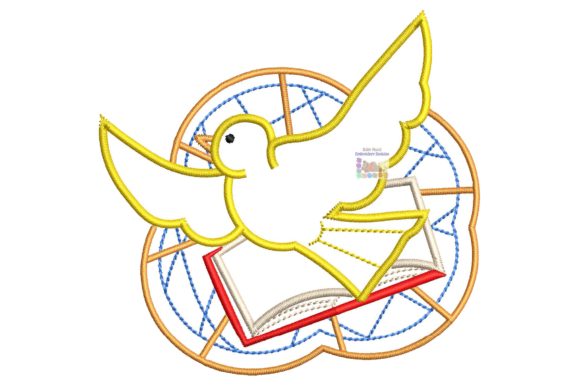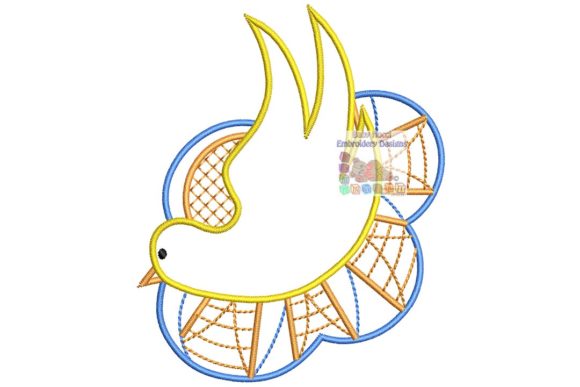
Dove Embroidery Design for Christian Projects
When you're creating faith-centered gifts, worship resources, or personal keepsakes, the right visual element does more than decorate—it invites reflection, conveys reverence, and deepens meaning. The Dove embroidery design stands out not just for its gentle aesthetic, but for how thoughtfully it supports the values and intentions behind Christian crafting. It’s not merely a motif; it’s a quiet, enduring symbol—of peace, the Holy Spirit, renewal—that resonates across generations and contexts.
Why This Dove Design Fits Real Creative Work
This particular dove design was developed with practical stitching in mind—not just digital appeal. Its clean lines, balanced proportions, and moderate stitch density make it reliable across fabric types: from terry cloth towels (where bulk can distort fine details) to lightweight cotton tees and brushed fleece sweatshirts. Unlike overly intricate motifs that require stabilizer stacking or slow-speed hooping, this version maintains clarity at standard commercial and home embroidery speeds—saving time without sacrificing dignity.
For educators preparing Sunday school materials, small business owners launching a faith-based apparel line, or hobbyists gifting baptismal towels, that reliability matters. You’re not troubleshooting thread breaks mid-run—you’re focusing on intentionality: choosing the right towel for a new parent, selecting a soft crewneck for a youth group retreat, or personalizing a journal cover for daily devotion.
More Than Decoration—A Tool for Intentional Expression
Christian projects often carry emotional or spiritual weight. A baptism gift isn’t just “something nice”—it’s a tactile reminder of covenant and grace. Here, the dove functions as both visual anchor and theological shorthand. Its presence on a hand-embroidered linen napkin for a church potluck communicates care and continuity. On a child’s backpack strap, it offers subtle encouragement without overt proselytizing. That duality—gentle yet meaningful—is why creators consistently return to this design when authenticity matters more than trendiness.
Freelancers designing custom merchandise for ministries appreciate how easily it integrates into broader branding. Pair it with a simple serif font for a scripture verse, or let it stand alone on a minimalist tote—either way, it reads as cohesive, reverent, and unhurried. There’s no visual competition, no stylistic whiplash. It supports the message instead of overshadowing it.
Practical Fit Across Fabrics and Use Cases
Because this dove design was digitized with fabric behavior in mind, it performs well where others struggle:
- Towels: Uses slightly open satin stitches and reduced underlay to prevent puckering on looped terry—ideal for baptismal, confirmation, or hospital ministry gifts.
- T-shirts: Optimized for knit stability; minimal pull compensation means less risk of distortion on curved hems or side seams.
- Sweatshirts and hoodies: Handles fleece pile with controlled stitch angles—no sinking or shadowing, even on dark heather gray or navy.
- Home textiles: Works cleanly on tea towels, pillowcases, and altar linens when stitched with appropriate thread weight (e.g., 40-weight rayon for sheen, 60-weight polyester for durability).
That adaptability makes it especially valuable for small business owners who juggle multiple product categories—say, launching a seasonal collection that includes both apparel and home goods. One design file, intelligently scaled and tested, reduces prep time and increases consistency across SKUs.
Who Benefits Most—and Why
This dove design serves creators who value substance over spectacle. It’s especially helpful for:
- Educators and ministry staff who need reproducible, respectful visuals for teaching tools, event banners, or volunteer appreciation items—without requiring graphic design expertise.
- Hobbyists and grandparents who want to create meaningful heirlooms (like embroidered baby blankets or first-Bible covers) but prefer clear, forgiving files over complex layered designs.
- Small batch apparel makers building ethical, locally stitched collections—where every minute saved in digitizing or re-hooping translates directly into sustainable pricing and manageable workloads.
- Bloggers and content creators developing printable + physical resource bundles—using the dove as a unifying visual thread across downloadable devotionals and companion embroidered bookmarks or pouches.
It’s less suited for high-fashion editorial pieces demanding avant-garde abstraction—or for mass-production runs requiring ultra-high-speed optimization beyond typical home or mid-range commercial machines. If your workflow relies heavily on automated multi-head embroidery or requires extreme scalability (e.g., 500+ units per hour), consult your digitizer about minor tweaks—but for the vast majority of faith-based creative work, it’s ready to use as-is.
Thoughtful Integration, Not Just Placement
Where you place the dove matters as much as the design itself. On a towel, centering it just below the top hem creates balance and avoids visual competition with the fold. On a T-shirt, positioning it left-chest (not dead-center) feels more personal and wearable—especially for teens or young adults who may resist overt symbolism. For sweatshirts, consider stitching it subtly on the inside back neck seam—a quiet nod visible only when intentionally shared.
These aren’t arbitrary suggestions. They reflect real feedback from pastors, craft fair vendors, and homeschool co-op coordinators who’ve observed what resonates—and what gets folded away after one use. The most effective Christian projects don’t shout; they linger. And this dove, stitched with care on a well-chosen fabric, does exactly that.
A Resource That Grows With Your Practice
Over time, many users discover this dove design becomes part of their creative vocabulary—not a one-off purchase, but a trusted element they return to season after season. One blogger uses it to mark quarterly scripture series on her printed planners; a women’s ministry team embroiders it onto reusable shopping bags for outreach events; a seminary professor incorporates it into student-made liturgical stoles.
That versatility emerges not from gimmickry, but from thoughtful proportion, theological appropriateness, and technical soundness. It doesn’t compete with text, overwhelm texture, or demand special handling. It simply belongs—whether on a $12 cotton tee or a hand-dyed linen altar cloth.
If you’re evaluating embroidery designs for Christian projects, ask not just “Does this look nice?” but “Does this support my purpose? Does it respect the people who’ll receive it? Does it work reliably in my actual workflow?” The Dove embroidery design answers yes—to all three.